Why Instagram Followers Drop After Buying — And How to Actually Stop It
By Telesmm Team, Growth Experts · 9 min read
Instagram isn't punishing you for buying followers — it's deleting dead accounts. Here's the difference, and the 14-day test that tells you if a panel is worth trusting.
You paid for 10,000 followers. Three days later you're at 7,400 and falling. Nothing in your dashboard explains it, and the seller has gone quiet.
This happens to almost everyone at least once, and it is not random. When Instagram followers drop after buying, there are only four things that can cause it — and three of them you can control before you place the order.
This guide explains exactly what's happening behind the scenes, how to read the service labels that panels use (refill, non-drop, guaranteed, high quality), and how to test any provider for under ₹100 before you trust them with a real budget.
What actually happened on 6 May 2026?
Overnight, Instagram wiped millions of follower counts across the platform. Users called it the "Great Purge of 2026." Kylie Jenner lost roughly 14 million followers. Instagram's own official account reportedly lost close to 9 million.
Meta's response was short and revealing. A spokesperson said: "As part of our routine process to remove inactive accounts, some Instagram accounts may have noticed updates to their follower counts. Active followers remain unaffected, and any restored suspended account will be included in the count again after verification."
Read that again, because it's the single most useful sentence in this whole article. Routine process. Active followers remain unaffected.
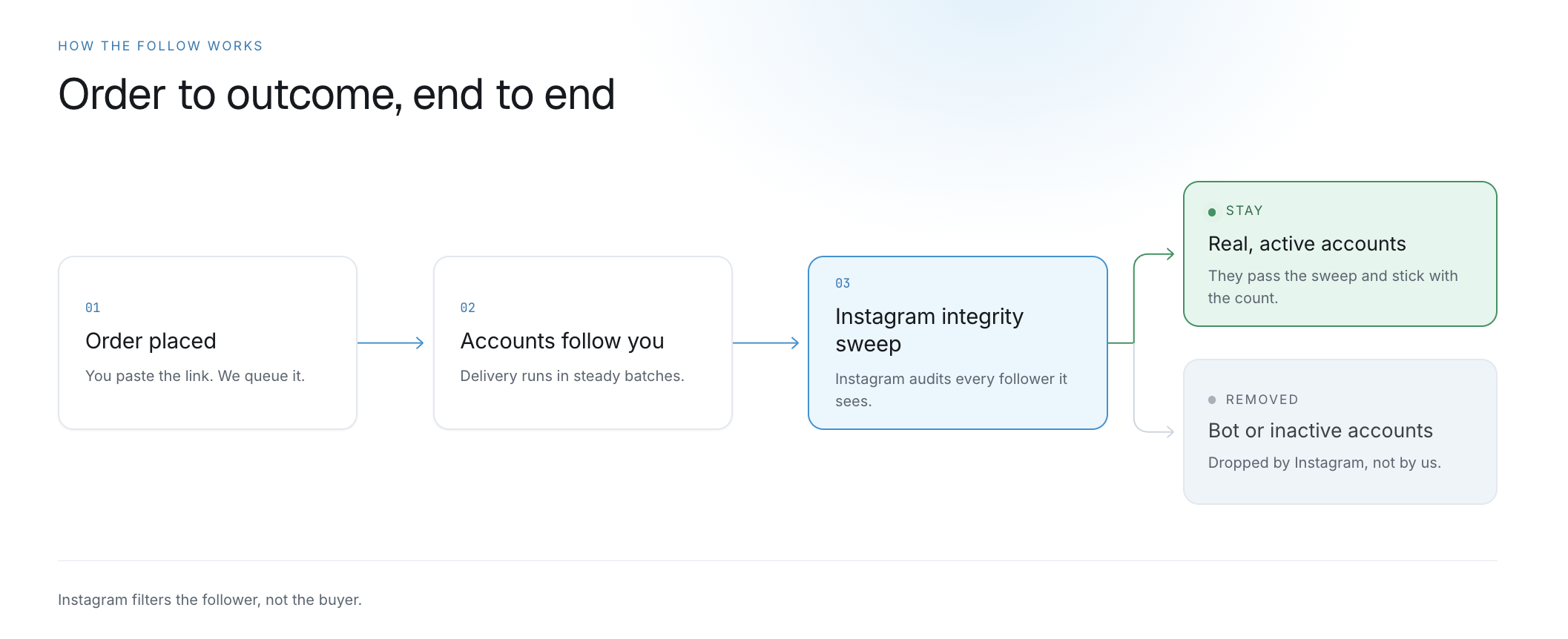
That tells you two things. First, these sweeps are not one-off events — they run continuously and occasionally run hard. Second, Instagram's filter isn't "was this follower bought?" It's "is this account alive?"
That distinction is the entire game.
Does Instagram detect that you bought followers?
Not in the way most people fear. Instagram does not scan your account, find a purchase, and punish you for it.
What its systems do is remove accounts that behave like automation — no profile photo, no posts, mass-following thousands of profiles in minutes, logins from server farms, recycled phone numbers. When those accounts get removed, everyone following from them loses a follower, whether that follower was bought, farmed, or picked up naturally.
So your account isn't being targeted. Your followers are. You just feel it more sharply because thousands of them arrived on the same day from the same source.
This is why "will I get banned?" is usually the wrong question, and "what kind of account is this follower?" is the right one.
The four reasons Instagram followers drop after buying
Every drop you'll ever see falls into one of these. Knowing which one you're looking at tells you whether to ask for a refill, change providers, or do nothing.
1. The integrity sweep (24–72 hours, sharp and sudden). Bot accounts get removed in batches. If a big chunk of your order vanishes within the first three days, you bought from a bot farm. This is the drop that's genuinely the provider's fault.
2. Natural account death (slow, forever, unavoidable). Real people delete accounts, go private, get suspended, or abandon Instagram. Every account on the platform loses followers this way, including yours before you ever bought anything. A slow trickle over months is normal and no provider can refill it away.
3. Mass unfollow from engagement schemes (7–14 days). Some services deliver followers from "follow-for-follow" networks — real accounts that follow you, then run an unfollow script a week later. The accounts still exist, so they never show up as removed. They just left.
4. Delivery breakage (during the order). If you switch your profile to private, change your username, or hit Instagram's own follow-rate limits mid-delivery, the order stalls. The count looks wrong because the order never finished — not because anything dropped.
The timing tells you which one you have. Sudden and early is type 1. Gradual over weeks is type 2. A clean cliff around day 10 is type 3. Mid-order weirdness is type 4.
What do "refill", "non-drop" and "guaranteed" actually mean?
These three words appear on nearly every panel in the market, and they do not mean what most buyers assume.
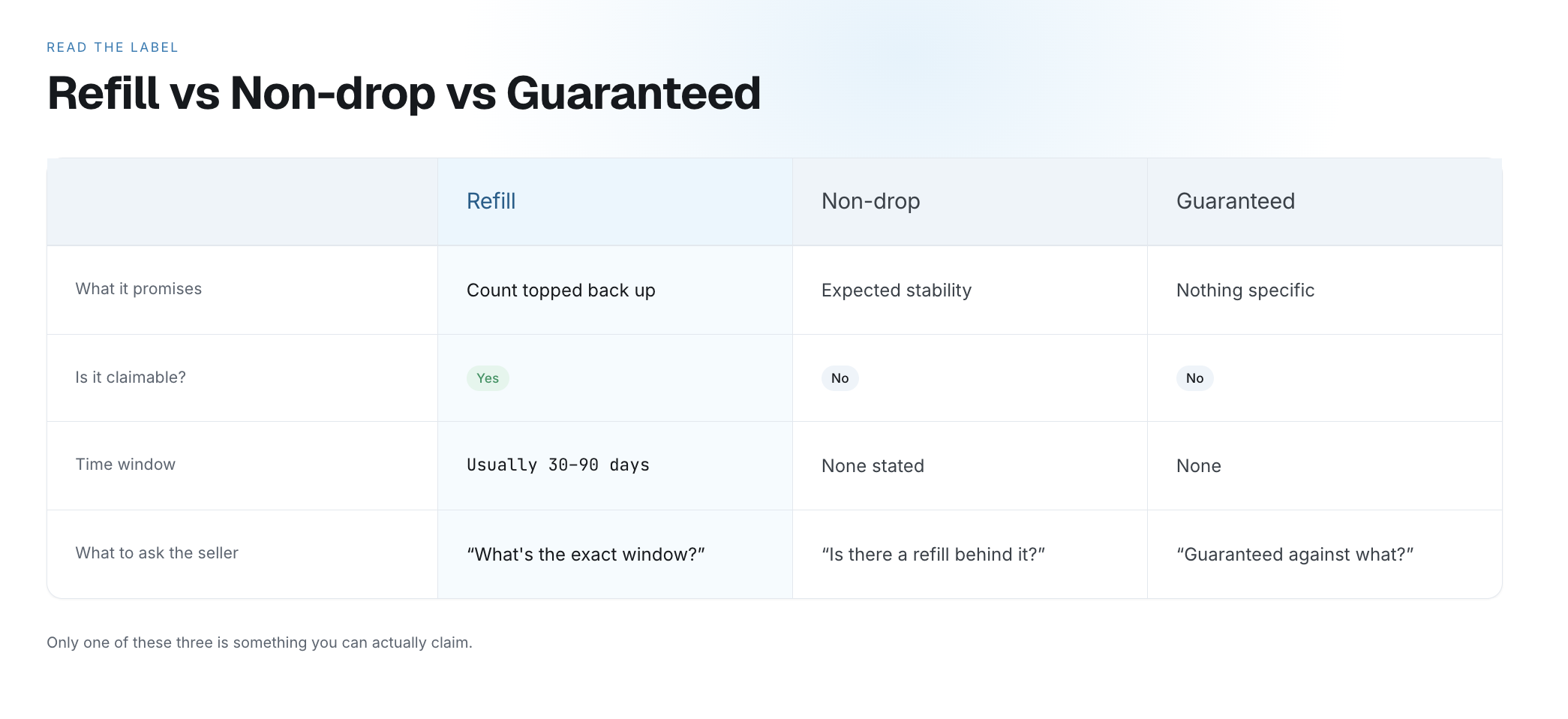
Refill is a promise to top your count back up if it falls below the delivered number, within a stated window — commonly 30 days, sometimes 60 or 90, occasionally "lifetime." It is the only one of the three that is an actual, claimable commitment. The window is the thing that matters, not the word.
Non-drop is a description of expected quality, not a warranty. It means the provider believes these accounts are stable. If they drop anyway and the listing carries no refill window, you have nothing to claim.
Guaranteed on its own means nothing at all. Guaranteed what? Delivery speed? Count? Retention? If the listing doesn't name what is guaranteed and for how long, treat it as decoration.
A refill also usually comes with conditions almost nobody reads: the account must stay public for the whole window, you must not have placed another order on the same link, and the claim must be raised within the window, not after it expires.
Why the price tells you exactly what you're buying
Follower services are priced per 1,000. The spread across the market is enormous, and it is not arbitrary — it is a direct readout of where the accounts come from.
At the very bottom of the market, you're buying scripted accounts created in bulk with disposable numbers. They cost almost nothing to produce, which is precisely why they cost almost nothing to buy, and why Instagram's sweeps find them first.
In the middle, you're buying aged accounts with some history — profile photos, a few posts, a plausible follow graph. They survive sweeps far more often, and they cost more because keeping an account alive costs someone money every month.
At the top, you're paying for genuinely active accounts, usually with geographic targeting. Retention is high and the price reflects the real cost of acquisition.
The uncomfortable truth: a provider selling at the bottom of the market cannot honour a meaningful refill guarantee. If their supply gets wiped every sweep, refilling it repeatedly would cost more than they charged you. So they don't — they go quiet, exactly like the seller in the opening of this article.
When a price looks impossible, the refill policy is what's paying for the discount.
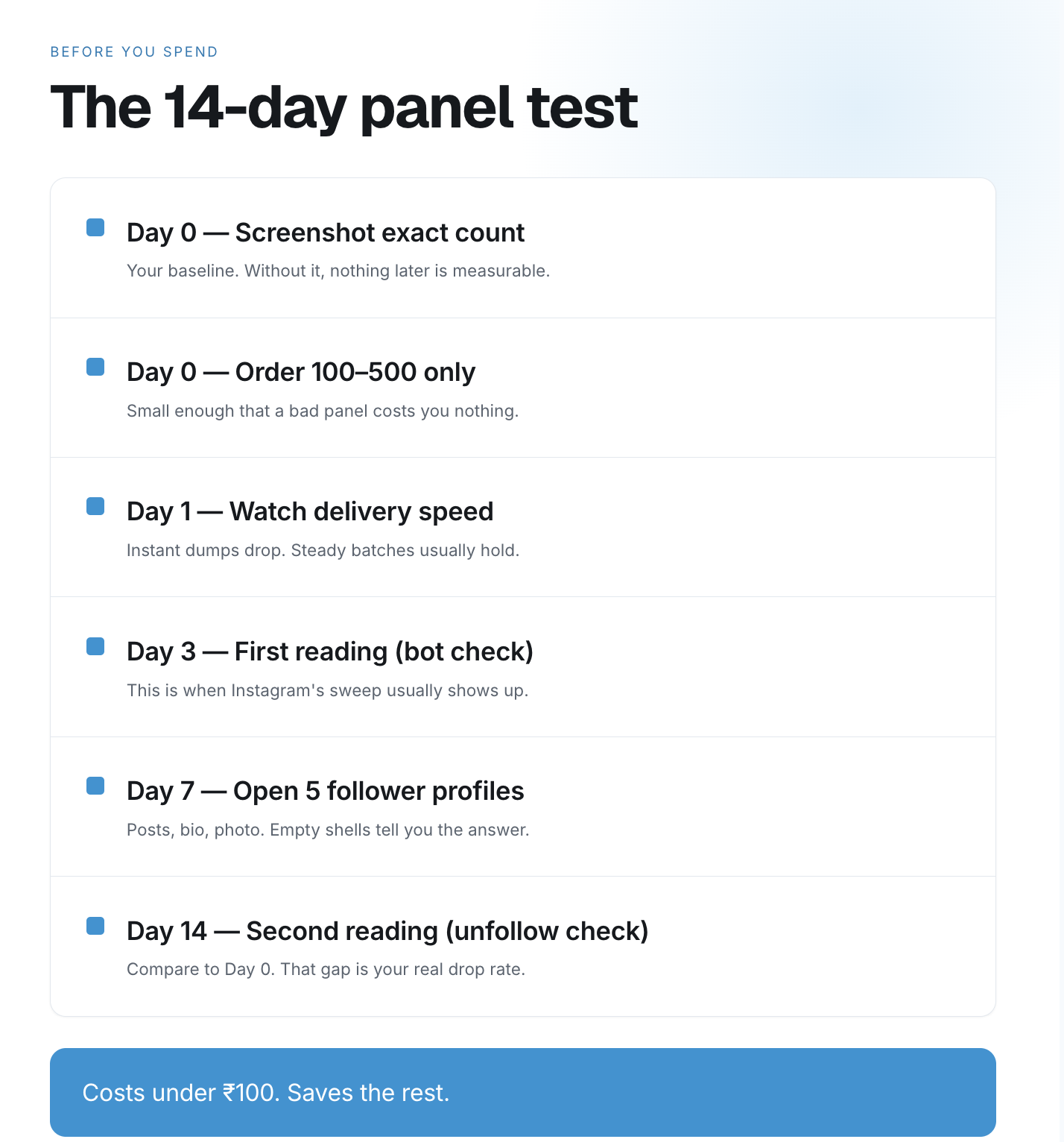
How to test any SMM panel for under ₹100
This is the part almost nobody does, and it's the single highest-return habit you can build as a buyer. Never hand a new provider a large order. Buy the smallest quantity they allow and watch it for two weeks.
Day 0 — Record your baseline. Screenshot your exact follower count before ordering. Not approximately. Exactly. Without this number, no refill claim is provable.
Day 0 — Order small, on a throwaway-scale budget. 100 or 500 followers. Keep the profile public and don't change the username until the test ends.
Day 1 — Check delivery speed. Instant, complete delivery of a large batch is a warning sign, not a feature. Real-looking growth arrives over hours.
Day 3 — Take the first reading. This catches the integrity sweep. Losing more than a small fraction here means bot supply. Stop the test and move on.
Day 7 — Open five of the new follower profiles. Do they have a profile photo? Any posts? Are they following 7,000 accounts with 12 followers of their own? Five profiles tells you more than any sales page.
Day 14 — Take the second reading. This catches the unfollow-scheme drop. A clean count here means the supply is genuinely stable.
Day 15 — Test support before you need it. Send a small, polite question and time the reply. A provider who answers a ₹50 customer in an hour will answer you when a ₹5,000 order goes wrong.
Only after a provider passes all six steps should they get a real order. The test costs less than a coffee and it has saved buyers in this market amounts they'd rather not talk about.
The drop already happened. What now?
Check the timing first. Pull up your screenshot and work out which of the four drop types you're dealing with. This decides everything else.
Raise the claim inside the window, in writing. Send your baseline screenshot, the order ID, the delivered quantity and the current count in one message. Most refill claims fail on missing evidence, not on bad faith.
Don't stack a second order on top. Ordering again on the same link while a claim is open voids most refill policies and makes the drop impossible to attribute.
Don't panic-switch everything. Losing followers does not damage your account's standing. Your reach is driven by how the people who do see your posts respond to them, not by the number under your name.
Then fix the supply, not the symptom. If the drop was type 1 or type 3, refilling from the same source gives you the same result in a month. Run the 14-day test on a different provider instead.
What's different about the Indian market?
Two things that matter practically.
Audience geography affects retention more than people expect. If your content, captions and existing audience are Indian and your followers arrive from a completely unrelated region, the mismatch shows up in your engagement rate immediately — and mismatched supply is often the cheapest, least stable supply on the panel. Ask where the accounts come from.
Payment method quietly tells you who you're dealing with. Providers running proper UPI collections have a verified business identity behind them and a payment trail you could actually reference in a dispute. That's a meaningful trust signal in a market where plenty of sellers operate from an anonymous chat window and a wallet address.
What separates a provider worth keeping
Strip away the marketing and there are only four questions worth asking any panel:
Where do these accounts come from, and are they region-matched to my audience?
What is the exact refill window in days, and what voids it?
How fast does a human reply when something goes wrong?
Will they let me place a 100-follower test order without pressure?
A provider who answers all four plainly is worth more than one who's 20% cheaper. The cheap order you have to replace twice was never cheap.
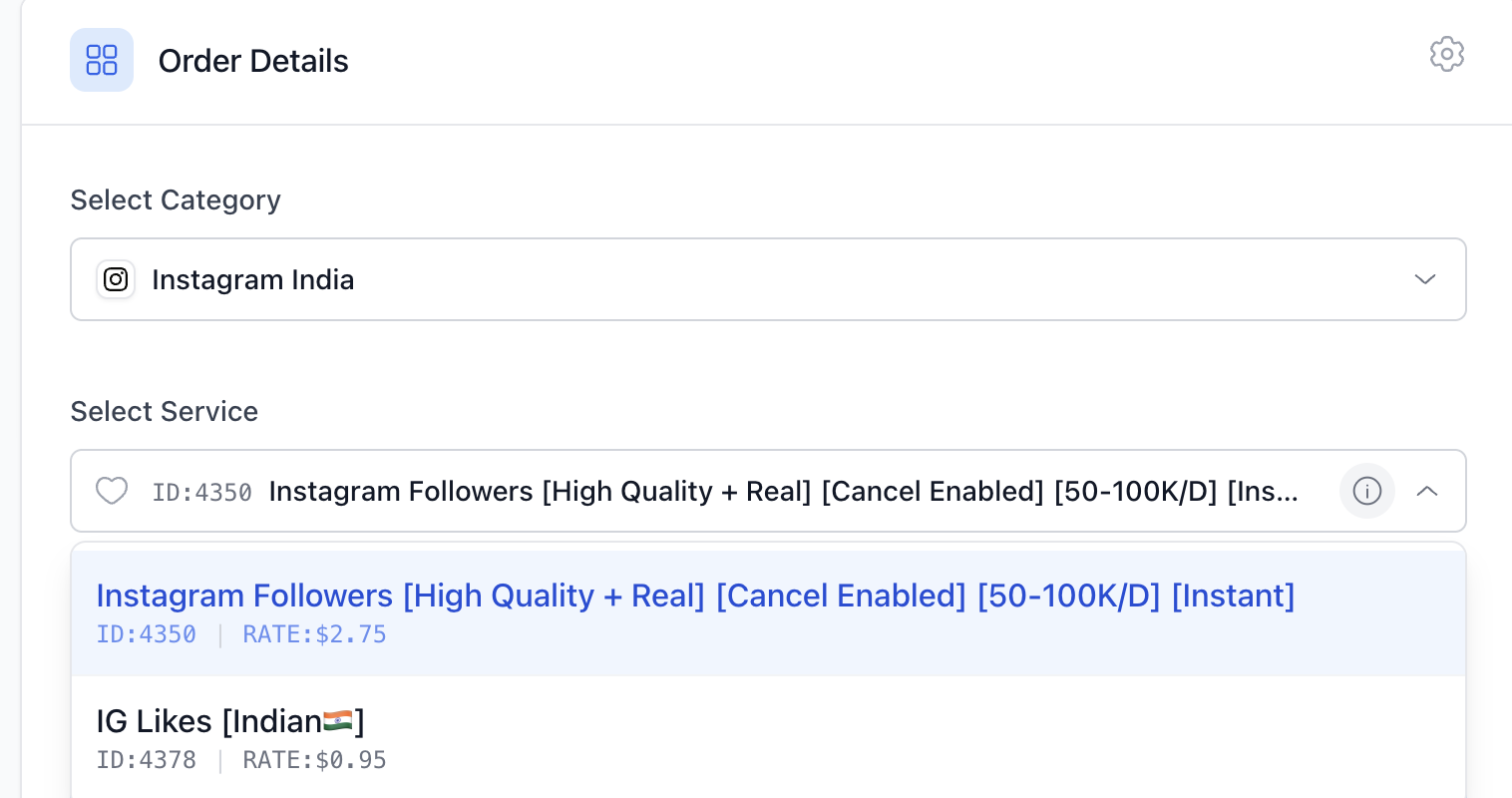
At Telesmm, the services are hand-picked rather than bulk-imported from whatever wholesale feed is cheapest that week — which is the whole reason a small test order is something we'd rather you run than skip.
Frequently asked questions
Will Instagram ban my account for buying followers? Account bans for buying followers alone are rare. Instagram's enforcement focuses on removing the inauthentic accounts themselves. The realistic downside is losing what you paid for, plus an engagement rate that looks wrong to anyone evaluating you.
How much drop is normal? A small, slow decline over months is normal for every account on Instagram. A sharp fall within the first 72 hours is not normal — that's bot supply being cleared.
Does a refill guarantee mean my count can never drop? No. It means the provider will top your count back up if it falls below the delivered number within a stated window. Outside that window, or if you broke a condition like going private, there's nothing to claim.
Are drops worse after a big purge like May 2026? Sweeps of that size are infrequent, but smaller ones run constantly. Accounts that survive the routine sweeps are generally the ones that survive the big ones too — which is why supply quality, not timing, is what you should be buying on.
Should I buy followers at all? If you're doing it for social proof ahead of a launch or a brand pitch, understand that you're buying a number, not an audience. Engagement is what people actually judge you on — see our guide on why follower count isn't the metric that matters.
The short version
Followers drop because Instagram removes dead accounts, not because it caught you buying. The fix is never a better guarantee — it's better supply.
Record your baseline, order small, check on day 3 and day 14, and only scale up with a provider that survives both readings. That one habit prevents almost every version of this problem.
Ready to run the test? Place a small order on Telesmm and check it on day 3 and day 14 — that's exactly how we'd want you to judge us.